
Dentures – Buzzards Bay, MA
Reliable Tooth Replacement Solutions
Various circumstances, such as gum disease or dental trauma, may have robbed you of a number of your teeth. Perhaps you are even missing all of your teeth. In either case, we invite you to visit us for a restorative dentistry consultation. After we examine your mouth and talk to you about your oral health goals, we may recommend that you receive full, partial, or implant dentures. These reliable tooth replacement solutions have already helped countless patients in Buzzards Bay — they may be able to help you as well!
Why Choose Canal Side Family Dental for Dentures?
- Experienced, Detail-Oriented Team
- Treatment Customized for Each Unique Patient
- Conventional and Implant Dentures Available
Who Is a Good Candidate for Dentures?
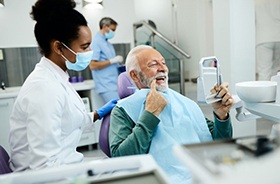
Dentures can be a great tooth replacement option for almost anyone. Whether you are missing several teeth or a whole arch, a well-made prosthetic can restore reliable function and even boost your confidence in your smile. But are dentures really right for you? Our team can help you determine the answer to that question. Even if you are not a candidate right now, you might be able to become one after some preliminary care.
Effects of Missing Teeth

Missing teeth can be the result of a number of sad circumstances, such as gum disease, facial trauma, genetically weak teeth, and certain lifestyle choices. Regardless of why you are edentulous (without teeth), your condition may have some profound effects on your health and daily routine.
For example, you may struggle to eat a wide variety of nutritious foods. You might also feel self-conscious due to the way your smile looks. Some people with missing teeth even experience intense feelings of sadness that cause them to draw away from social situations, leading to loneliness.
Yes, tooth loss can be devastating. But there is good news! Dentures can reduce or even eliminate many of the consequences of an incomplete smile.
What Qualifies You for Dentures?
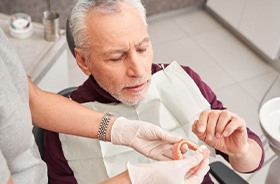
Dentures may be the perfect solution for you if:
- You struggle with the life-altering effects of missing teeth, such as difficulty chewing, a lack of self-confidence, and speech problems.
- Your remaining natural teeth are unhealthy and may soon need to be extracted.
- Your tooth loss is somewhat extensive. (If you are only missing one or two teeth, dentures may not be appropriate for you.)
- Your gums and underlying jawbone are healthy enough to support a prosthetic.
- You are looking for an efficient and reliable way to rebuild your smile.
During your consultation, our team will examine your mouth and let you know which type of dentures might be the best way to rebuild your smile.
Alternative Tooth Replacement Options
What if it turns out that dentures are not quite right for you? Our team will likely suggest an alternative form of tooth replacement, such as:
- A fixed bridge. A fixed dental bridge has a crown on each end, which get attached to your remaining healthy teeth. The crowns support one or more artificial teeth between them. Bridges are very sturdy and have the potential to last for a decade or longer.
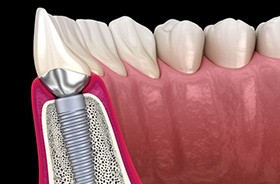
- Dental implants. Dental implants are prosthetic tooth roots that get surgically placed into the jawbone. They can support crowns, bridges, and dentures. They provide many benefits that you cannot find with other forms of tooth replacement — such as outstanding strength and longevity — so we often recommend them as the best solution for qualifying patients.
Types of Dentures
When you visit us for your consultation, we will carefully examine your mouth and learn about your goals for treatment. Depending on what we discover, we will recommend the type of prosthetic that best fits your situation. We might tell you that a partial denture, full denture, or implant denture would be a great way to restore your smile.
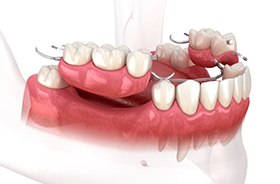
Partial Dentures
A traditional partial dentureis a one-piece prosthetic that can replace multiple teeth at various places throughout a dental arch. You can think of it sort of like a puzzle piece that fits in exactly where it is needed. Small metal or acrylic attachments help a partial denture to remain secure through eating and speaking.
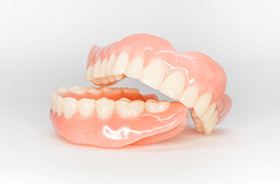
Full Dentures
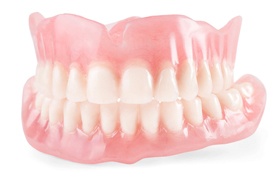
A traditional full denture consists of a gum-colored acrylic base that is attached to a full arch of porcelain or acrylic teeth. Natural suction or a mild adhesive helps the denture to stay in place throughout the day. Dentures are always fitted to a patient’s unique mouth so they fit snugly but comfortably.
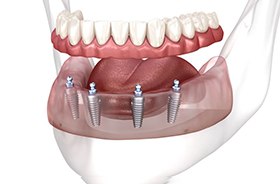
Implant Dentures
An implant denture does not rely on suction, adhesive, or metal clips to remain in the mouth. Rather, it is anchored in place by small titanium posts (dental implants) that act as substitutes for the roots of the missing teeth. We often recommend implant dentures as the best option for patients who are candidates for the procedure.
How Dentures Are Made

As your dentures dentist in Buzzards Bay, our team is excited to help you rebuild a confident and functional smile! However, even if you have already committed to getting dentures, we understand if you have questions about the road ahead. What exactly are dentures made of, and how are they created? Continue reading below to get a basic understanding of this remarkable process. Hopefully, what you discover will heighten your appreciation for your new teeth!
What Are Dentures Made Of?
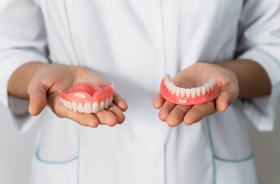
Dentures have two main parts:
- The base of dentures is usually made of acrylic, which can be molded to fit the unique contours of your gums. In some cases, nylon is used instead. If you are getting partial dentures, the base of your prosthetic should also have acrylic or metal clasps that will help it to stay secure in your mouth.
- The artificial teeth that are attached to the base are typically made of acrylic or porcelain. Acrylic is a bit softer and easier on natural teeth, so it is used more often for partial dentures, while porcelain is the material of choice for full-mouth tooth replacement.
The Denture Creation Process
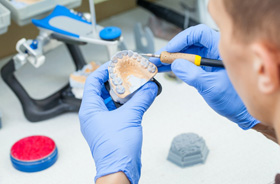
The denture creation process involves multiple steps:
- Consultation and Impressions: Your journey will begin with a thorough consultation, during which our team will discuss your needs and take highly accurate digital impressions of your mouth. These impressions are vital for creating an accurate model of your gums and any remaining teeth.
- Model and Measurements: A laboratory will use impressions and measurements from our team to create a wax model of your gumline. A machine called an articulator will set artificial teeth into it. The lab will send the wax-up back to us so you can try it on in our office.
- Fittings: We will provide the lab with feedback on the denture model. You might need to come in for multiple fittings as we strive to make sure that the design of your prosthetic is just right.
- Fabrication of Dentures: After the design is finalized, skilled technicians will use the model to fabricate your dentures.
- Final Adjustments: Once your new dentures are ready, you will return to our office, where we will check the comfort, appearance, and function of your prosthetic. We will make any necessary final adjustments so your dentures feel as natural as possible and suit your smile.
- Final Instructions: Before you leave, we will provide guidance on caring for your dentures and adapting to daily use.
Adjusting to Your New Dentures

There is a bit of a learning curve when it comes to adjusting to new dentures. You might produce extra saliva for a while, and your gums may be a bit sore. Some speech challenges are also common. These issues are usually mild and tend to go away with time. You can make the adjustment period a bit easier by practicing your speech and eating soft foods. If you have any ongoing issues with your new dentures, contact us so we can provide the needed assistance.
The Benefits of Dentures

Dentures offer a number of outstanding advantages:
- An expanded diet. Traditional dentures and partial dentures can restore your ability to eat a wide variety of foods. Implant dentures even function similarly to natural teeth.
- A beautiful smile. Our team designs dentures based on each patient’s unique orofacial structures with the goal of making the prosthetics as natural-looking as possible.
- Longevity. Non-implant dentures typically last for at least 5 years, whereas implant-supported dentures can last for decades.
- Easy care. It is neither complex nor time-consuming to keep a denture clean and fresh.
- Affordability. Traditional dentures are a relatively inexpensive tooth replacement option. If you would like implant-supported tooth replacement, our team will help you explore resources that could help you afford your procedure.
What Is the Dentures Process?
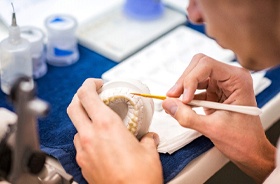
The exact process for creating traditional dentures varies from patient to patient. We may need to extract some of your remaining teeth and address existing oral health procedures before we provide your prosthetic. Once your mouth is ready, we will take detailed impressions and images of it and use those to design your new teeth. Then, a dental laboratory will create your prosthetic. After we provide you with your new teeth, we will educate you on how to adapt to using them so you can get as much out of them as possible.
The implant-retained dentures process is more complex and may take several months or longer to complete. Our dental implants page has more information about this remarkable treatment.
Would you like to learn more about how our team can restore your teeth with dentures? Contact us today to request a consultation.